
Within each of us is a presence that has always been watching. It’s steady, clear, and waiting to be found.
Not long ago, I was invited by Body & Brain Yoga and Tai Chi to offer an online keynote training for a nature meditation tour of the North Island of New Zealand near the Earth Village. What I shared that day is something I have returned to many times over the decades, because it addresses something that does not go away on its own: the emotional weight we carry, the roots beneath our feelings, and the part of us that is capable of seeing all of it clearly.
What We Carry
We are all familiar with difficult emotions—sadness, loneliness, anger, fear, the ache of feeling unseen. Most of us have learned how to deal with these feelings in some way. Maybe we push through them or set them aside. Unless we heal negative emotions, however, they will remain in our bodies and our psyche, burdening our daily lives.
Healing means becoming clear, whole, and free at every level of our being, and healing our emotions is a fundamental part of that. In order to do that, it’s important to look at what lies beneath our feelings, to go down to their root. When we can see that clearly, we are no longer at their mercy.
At the root of many of our emotions is the desire to possess. Everyone has the desire to possess; it’s part of being human. When we don’t get what we want, though, we can feel sad. Going further, we develop anger. Sometimes we even develop feelings of despair, and become mired in weakness. These feelings arise from that place of wanting to hold on.
There is also the desire for recognition. We feel alienated and lonely when we cannot get the recognition we seek. We feel anger, too.
And there is within all of us a desire to love and be loved. When that love is not accepted, when we have been rejected, we feel saddened. In severe cases, we may be wounded even more deeply through that wound.
These desires are at the root of many emotions. They stir up ceaseless feelings within us. People generally mistake those emotions for who they are. They say, “I’m sad. I’m lonely. I’m joyful. I’m happy. I’m peaceful.”
However, it’s important to understand that these feelings are not who we are. They come from our desires, just as shadows come from objects placed before a light. We possess these feelings the way we have eyes and ears. They belong to us. We are their master. They are not us.
Neither our desire to possess, our need for recognition, our desire for love, nor the things we possess are who we are. Who, then, are we? We can encounter ourselves deep inside. We can proclaim: “I am me,” separate from all these possessions and attachments.

A Healing Practice
We can encounter the self that’s beyond our desires and the emotions that stem from them through meditation. We do not need to be on a mountain or in a forest to practice it. We can begin right where we are.
Try this meditation involving watching ourselves. Looking inside may be unfamiliar at first. We begin with the solid sensations of the body, move into the heart, and finally into the witnessing presence within us that has always been there.
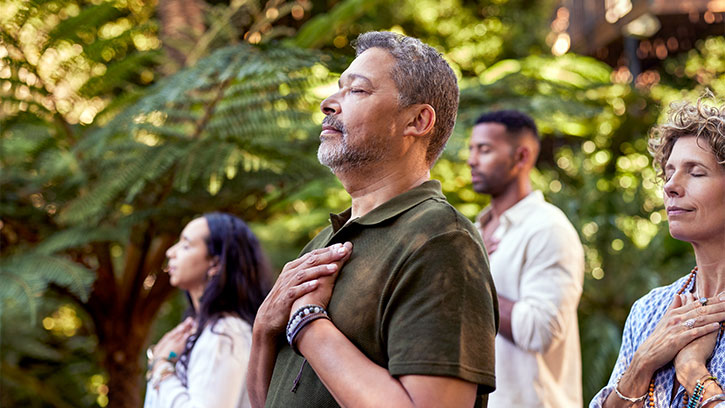
First, find a place without distractions. Sit or stand comfortably with your back straight and close your eyes.
Feel your body from the top of your head to the tips of your fingers and toes. Right now, feel the physical condition of your body. As you scan down your body, relax each part, from your head, neck, shoulders, and arms to your torso, back, hips, legs, and feet. As you relax your body, let your mind become more peaceful.
Imagine energy coming into your body from the top of your head and flowing all the way down. Entrust your body to this energy. If you are experienced enough and/or can feel the energy, you can let your body move with the energy, putting yourself in a very peaceful state.
Being peaceful means being free. Compassion develops within this peace. Love wells up from within. When we are at peace and feel love within, we are ready to give others energy.
Now slowly raise your hands. Before us is someone we would like to heal. It is someone we love, and someone we want to give love to. It is someone who wants to receive love from us. Look at that person. Peace and love fill us. Now express that love. In the instant we make up our minds to do that, our hands move, our facial expressions change, and a loving, peaceful energy comes from us.
Share your love, your peace, through energy. Say what comes naturally. A healing message rises from within. I can feel your heart. I understand. I truly love you. I want to give you peace. I want to share my love with you. Continue until the other person is completely happy and peaceful.
The person before us has the same hurts we have, the same loneliness. That person is us. When we heal that person, we too, are healed. True healing is received as it is given.
As messages of love continue to come from our lips and the energy of love comes from our hands, we can look at what lies beneath our own feelings. We see the desire to possess. We see the desire for recognition. We see the desire to love and be loved, and the pain of times when that love was not returned.
Watch these feelings. Do not push them away, and do not chase after them. Simply watch.
This is how emotions are healed in a fundamental way.
The One Who Watches
There is a part of us that does not change with our emotions. It has been watching over us all along, even when we did not know it. That part is what we call our observer consciousness—the aspect of our mind that sees, hears, and feels everything clearly, without attachment or judgment, without being swept away.
Emotions are like clouds. They shift and change. But our essence, our observer consciousness, does not change. It watches all things. Our sadness and our joy are both clearly seen from that place. The roots of our emotions are clearly seen from that place. When we can see ourselves clearly from there, we can see others clearly too.
This is not something we have to create or develop from scratch. It is already within us. It has been there all along, quietly watching, brightly present.
My body is not me, but mine. My emotions are not me, but mine.
When we can feel this truth in our bodies and not just understand it in our minds, something shifts. We no longer identify with the feelings that come and go. We are the ones who notice them. From that place of clear seeing, we can choose. We can create emotions rather than be ruled by them. We can respond to our lives with the wisdom of our true selves rather than the reactivity of old wounds.
From that seat, enlightenment is not a distant achievement. It is a choice we make, again and again, each time we remember who we are.
I Am Me
The practice I have shared here does not end when we open our eyes. We carry it into our day—into our kitchens, our workplaces, our relationships, the difficult conversations and the tender ones.
When we feel ourselves getting swept into old patterns, we can pause. We can breathe. We can return to the one who watches.
And we can say, out loud if we are able: “I am me.”
This “me” is not a role we play, nor the sum of our wounds or our achievements. It’s not the emotions moving through us. We are something steadier and brighter than all of that.
To have found this self—how long have we wandered? The moment we feel and know ourselves, something in us comes alive. Love that self. Give your life to knowing and expressing that self. That is not a small thing. That is the most important thing.
I am me.
Related Posts
- How Can You Manage Your Thoughts and Emotions?
- Reveal Your Unconditional Value with Daily Mind-Body Training
- Take Back Your Brain!
- 5 Ways to Have the Courage to Be Yourself
- How to Clear Up Emotional Messes Every Day