
When we restore our internal peace through body and brain management, we create a ripple effect of compassion that can heal the world.
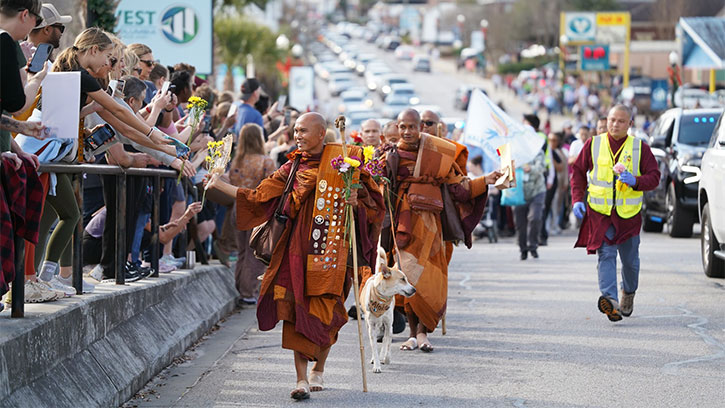
Recently, a group of Buddhist monks began a 2,300-mile journey on foot from Texas toward Washington, D.C. As we watch them cross state lines—stopping at historic landmarks like the Edmund Pettus Bridge to offer prayers—we are reminded of a profound truth. Their leader, Bhikkhu Pannakara, shared that they walk not to force peace upon the world, but to “awaken the peace that already lives within each of us.”
This beautiful sentiment resonates deeply with what I’ve been teaching. Whether it is a monk walking across the country or a mom practicing Brain Education at home, the principle remains the same: peace is not something we find outside; it is something we cultivate within.
Restoring the Observer’s Eye
That cultivation comes through meditation. Whatever form of meditation we choose to practice, the core of meditation lies not in purifying emotions or eliminating unnecessary information, although those are important. It goes deeper to restoring our “observer’s eye.” When we can see ourselves as we really are, we can give birth to our true selves. At that moment, we experience with our bodies, not just intellectually, that “my body is not me; it is mine. My emotions are not me; they are mine.”
If we are mired in a negative state, instead of fretting and expecting it to change on its own, we can enter a neutral state—a state of “nothingness.” It is in that state that the observer’s eye opens, and we can see beyond our thoughts and emotions. When we realize our emotions are not our essence, we stop being slaves to them.
Emotions and desires are like waves that we can learn to ride well. By learning how to ride them, they become energy we can use. Those who can choose and use emotional energy instead of getting mired in it can reach the peace inside.
It’s up to us to shake off negative energy—to get up, move, and change our environment. Movement is an important form of meditation. For through the body, we govern the mind. We choose our consciousness, and we manage it.

The Formula for Brain Management
In fact, consciousness management is brain management, and body management is consciousness management. This is an accurate formula. If our brain doesn’t think when it’s time to think or move when it’s time to move, we have lost our connection. We likely haven’t been managing our body and our muscle strength.
The first step in body management is sound management. Sound vibration is vital. By making a sound, we create vibrations that change our internal wavelength. While doing sound vibration, make any sound. Pick a mantra, sing a song, or just speak gibberish. Make sounds that resonate with different organs or chakras. It’s important to feel the vibrations. Feel them in our bodies, and if possible, feel them resonate in your chakras.
Besides sound vibration, we can use Brain Sports—which includes Brain Qigong, Brain Yoga, and Brain Meditation—to revive our vital energy and activate our divine energy.
When we strengthen our muscles with push-ups or squats and combine them with sound vibration, our breathing changes. Our language changes. We begin to see clearly whether we are using the language of hope and vision or the language of sighs and blame.
It’s important to check our brains this way—to check their style right now. Is it a style attached to little things, fussing over perfection and causing us pain? Or is it an optimistic style? Even hard labor can become “body-moving exercise” if our brains’ style is optimistic.
Peace comes from an optimistic brain style. When we manage our brains well and manage our consciousness well, when we reach the zero point of nothingness, our brains will naturally become positive. Our bodies and brains will be more connected, and imagination, action, and awakening will begin to align. Our words and actions will gain consistency, enabling them to be used effectively, especially in expressing the love and peace of our true selves.
Peace Begins with One
Besides emotion, loneliness is a common peace destroyer. We can feel lonely even in a group of people, and the pain of loneliness can lead to our lashing out against ourselves or others. Loneliness can be a cause of great strife in the world.
Yet, solitude—as opposed to loneliness—can bring peace. We all face solitude at some point. A spiritual journey in particular is often a solitary one. Even if we have a guide, in the end, we have only ourselves, heaven, and spiritual principles. But solitude is not empty; it is brilliant and full. Whereas loneliness leaves a hole inside us that generates feelings of inadequacy or lack, solitude feels secure and complete.
In true solitude, we reach the zero point and experience connection with all that is. We discover the great, pure love within us—a “divine nature”—waiting to be expressed and embodied. That means not getting caught up in trivial disputes and embracing the world with the heart of heaven. That’s when great compassion emerges.
Walking Toward Collective Peace
Great compassion is a catching thing. When one person has it, other people can sense it. Hearts melt from the waves of compassion vibrating from our awakened divine core. The monks walking across the United States say plainly that their walking itself cannot create peace. What matters is what awakens in the hearts of those who encounter them. A conversation softens. One person becomes more mindful. A small act of kindness passes to another. That is how peace moves.
As the monks continue their walk, we can join them in spirit by managing our own vibrations. By choosing to be people who love the earth and manage our consciousness, we become the “ripples” the monks speak of. One awakened heart at a time, we make the world more peaceful.
Related Posts
- 5 Ways Meditation Transforms Your Brain and Your Life
- Why Enlightenment Isn’t About Being Perfect: A Story of Buddha
- Ilchi Lee’s Breathing Method for Raising Your Consciousness
- 7 Ways to Take Back Your Brain
- Exercises to Connect to Your Body