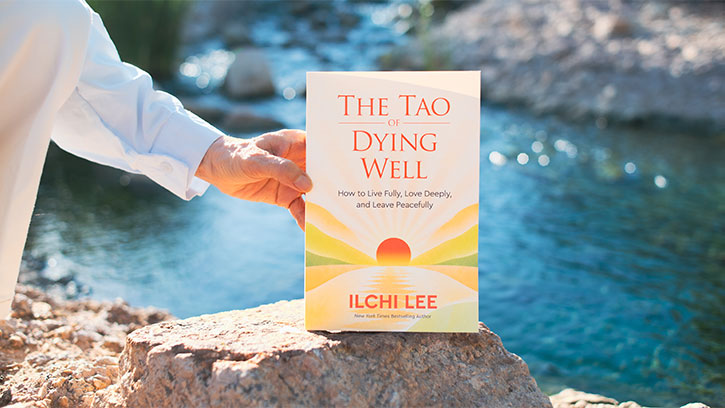
On October 20, my new book, The Tao of Dying Well, will be released.
It is a book about death. But even more, it is a book about what it means to be truly alive.
For many years, I have explored how human beings can live with health, happiness, and peace. In I’ve Decided to Live 120 Years, I invited readers to look beyond conventional ideas about aging and envision a longer, more purposeful life.
But when we follow the question of how to live well all the way to the end, we inevitably encounter another:
How can we bring our lives to completion?
This question became deeply personal as I accompanied my parents through their final years.
My mother passed away at 82. After a fall left her bedridden, she struggled to make peace with the final chapter of her life. She had always been spirited, strong-willed, and fiercely independent. Having to rely on others was painful for her, and that struggle stayed with her until the end.
My father passed away at 95. His body also weakened with age, but he met the end of his life differently. I spent his final two weeks by his side. He told me that he had lived without regret, that he was content, and that he was ready to go. Then, peacefully, he let go.
The difference had nothing to do with how much either of them suffered physically. Dying well is not determined by the condition of the body or by how easily death comes. What stayed with me was the difference in how my parents met the final chapter of their lives.
Their endings led me to meditate more deeply on what brings true peace to the human soul. I came to understand that living well and dying well are not separate matters.
The path to dying well is the path to living well until our final moment.
We Plan for Life, but Turn Away from Death
People naturally want to live well. We work hard, make plans, and prepare for a better future. We make plans for our careers, finances, families, and retirement. Yet the idea of preparing for death makes most of us uneasy.
We may spend years preparing to buy a home, months planning a trip, and even weeks researching a new phone. But when someone mentions death—something every one of us will face—we often turn away and say, “Let’s not talk about that.”
By “planning for death,” I do not mean deciding when or how we will die. I mean considering, while we are still alive, how we want to live until our final moment. What needs to be put in order? What do we hope to leave behind? With what state of mind do we wish to depart?
We cannot plan a whole life while ignoring its final chapter. When we accept death as part of life, how we want to live becomes clearer.
Death Asks Us to Be Honest
When we seriously consider what it means to die well, the way we see the time remaining to us begins to change.
- When my final moment comes, how will I look back on my life?
- Have I lived the life I truly wanted?
- Have I fully expressed my love and gratitude?
- What will I leave behind?
Death asks the questions that everyday life allows us to avoid. In their presence, we become more honest with ourselves. Impatience and greed loosen their hold. What truly matters comes into focus.
To contemplate death is not to turn away from life. It is to reclaim a life we may have allowed to pass unnoticed. It is to clarify what we are living for and, while there is still time, to love, forgive, give thanks, and begin the work that is ours to do.
This becomes especially important as we enter the second half of life. The question is no longer only how much more we can achieve or acquire. We must also ask how we will use the time that remains and bring our lives toward a meaningful completion.
This is what I call Chunhwa, or life completion.
A Book About How to Live
Although its title is The Tao of Dying Well, this is ultimately a guide to living.
I wrote it for those entering the second half of life who are reconsidering what matters most. I wrote it for those accompanying a parent or loved one through life’s final chapter. And I wrote it for younger readers, because none of us needs to wait for old age, illness, or loss to ask what we are here to live for.
When we recognize that our time is not unlimited, life becomes more precious. We become more willing to express love, offer forgiveness, release what no longer matters, and begin what we have postponed for too long.
We reflect on death not merely to prepare for the day we leave this world. We do it so we can fully live the life before us, here and now.
I hope The Tao of Dying Well will help you look at death with less fear and at life with greater clarity. I hope you will keep it close and return to it whenever you need to reconsider the direction of your life.
The Tao of Dying Well will be released on October 20. I hope it will help you live more fully, love more deeply, and approach life’s completion with greater peace.
I look forward to sharing it with you.
From the Editor: You can learn more about the book at TaoofDyingWell.com.
Related Posts
- How to Stop Living on Autopilot
- Who Is Steering Our Dream?
- Five Ways to Keep Our Brains Flexible and Creative
- Strive to Be Complete, Not Perfect
- I Give Birth to Myself