
When we deliberately meet resistance and tell our brains that change is possible, we build the confidence to create the lives we envision.
Many of us reach a point in life when we have become very good at managing what already exists. We fulfill our responsibilities, solve the problems in front of us, and try to preserve the stability we have worked hard to build.
There is value in stability. But without realizing it, we may begin organizing our lives around what feels manageable rather than what we truly want to create. We avoid taking on anything that might disturb the balance. We tell ourselves that we will begin when we have more energy, more time, or greater confidence.
Eventually, maintaining life can take the place of creating it.
This can happen even when we still have dreams. Part of us wants to move forward, but another part has already decided that the obstacle is too large. We interpret resistance as evidence that our goal may not be possible.
I see resistance differently. When an obstacle appears, I move more and I move faster. I do that because I have a vision.
Vision Changes the Meaning of an Obstacle
When our vision is weak, an obstacle can seem like a warning to stop. When our vision is clear, the same obstacle becomes something we can use.
Instead of allowing an obstacle to control me, I want to be the one who determines my relationship with it. I can look at it and say, “How strong is this obstacle? Is it a level two? A level five? What would it take to train myself to overcome it?”
This attitude transforms resistance into training. The obstacle is no longer an unwanted interruption. It becomes part of the path toward our vision.
I practice this principle when I ride my stationary bicycle. I deliberately choose the uphill setting, which can increase the resistance to many times the regular level. At first, even level two was difficult for me. But I continued training and increased the resistance one level at a time.
Now I can ride at level ten.
After fifteen minutes, sweat streams down my body, my breathing becomes heavy, and I feel the effort in my calves and thighs. I want to pedal faster, but the resistance prevents me from moving at the speed I want. That is when I press down through the yongchun points on the soles of my feet and pedal with greater determination.
I am not fighting against my body. I am teaching my body and brain how to respond when something becomes difficult.
What Are We Training Our Brains to Expect?
Every response we repeat becomes training for the brain. If we repeatedly withdraw as soon as we experience resistance, we teach the brain that difficulty means defeat. If we continually wait for ideal conditions, we teach it that we can act only when life becomes easier.
Then, when an unexpected obstacle appears, hopelessness and fear can arise automatically. We have practiced surrendering our authority to the obstacle.
But we can train a different response. We can choose an appropriate challenge and practice meeting it with energy, enthusiasm, and confidence. We can say, “I have been training for this. Let’s see what I can learn from it.”
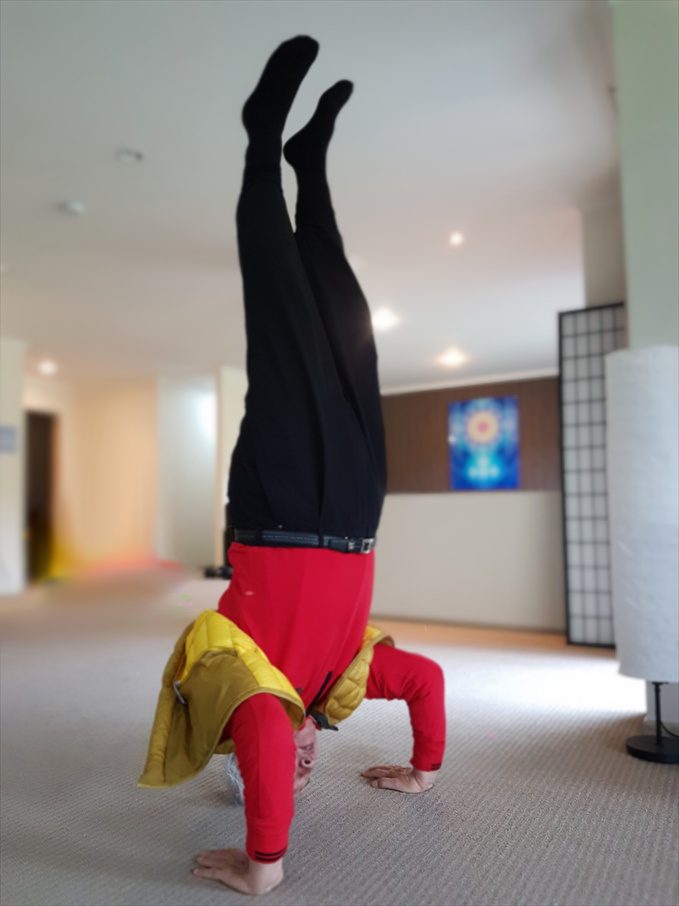
Confidence does not appear from nowhere. It is created through repeated choices. Each time we meet resistance and continue moving toward our vision, we give the brain new evidence of what we can do.
This does not mean ignoring an injury or pushing the body recklessly. The resistance we choose should be appropriate for our condition. When I began cycling, I did not start at level ten. I began with the level I could face, trained myself there, and gradually increased it.
We can approach the challenges in our lives in the same way. We do not have to conquer the largest obstacle today. We can choose our level two and begin.
Give the Brain a Message of Possibility
While I ride my bicycle, I do more than move my legs. I speak to my brain.
“I’m burning fat and building muscle.”
“The light of my vision is turning on.”
“I can do it.”
These words are not decorations placed on top of the exercise. They give the exercise a direction. They tell my brain what I am creating through my effort.
Sometimes people dismiss affirmations because repeating a sentence does not automatically change our circumstances. That is true. Words without choice or action can remain only words.
But when we affirm possibility while taking action, something different happens. The message and the movement support each other. Our words direct the brain, while our actions provide evidence that the words are becoming real.
If we tell ourselves, “This is impossible,” the brain will collect reasons to stop. If we say, “This is possible. What can I do now?” the brain begins looking for a path forward.
Calling something possible does not guarantee that every result will appear exactly as we imagined. It means that we do not impose the final limit before we have even begun. We allow the brain to explore, adapt, and create.

Choose a Challenge That Serves Our Vision
We can begin by identifying something we genuinely want to create. It may be greater physical strength, a new project, a healthier relationship, a meaningful contribution, or a change we have postponed because it seems too difficult.
Then we can choose a manageable form of resistance. What is the level-two challenge that would move us toward that vision? It might be exercising for fifteen minutes, making one phone call, sharing an idea, learning one new skill, or completing the first small part of a project.
As we take that action, we can consciously speak to the brain:
“This is possible.”
“I am becoming stronger through this challenge.”
“My vision is taking form through my choices.”
“I can take the next step.”
With repetition, we can gradually increase the level. What once required great effort becomes something we know we can handle. We discover that the obstacle was not only blocking our path. It was also developing the strength we needed for the next part of the journey.
Become the One Who Chooses
Life will bring us obstacles we did not choose. That is unavoidable. But we can choose whether we meet them with a brain trained in avoidance or a brain trained in possibility.
When we deliberately challenge ourselves, we become more than people who react to circumstances. We become active creators. We learn that resistance does not have the authority to determine the size of our vision.
The next time an obstacle appears, instead of immediately becoming discouraged, we can look at it with curiosity and confidence. We can say, “There you are. I have been training myself for this.”
What we choose as possible begins to activate the possibilities in our brains. Then, through movement, repetition, and action, possibility becomes ability. Ability becomes confidence. And confidence gives us the courage to create what did not exist before.
Let us choose our challenge, turn on the light of our vision, and move.
Related Posts
- Face Challenges and Ignite Creativity with the Energy of the Dragon
- Five Ways to Keep Our Brains Flexible and Creative
- Discover 3 Tao Insights That Free Us from Suffering
- Choose a Path to Success with 100% Positivity
- Ilchi Lee’s Picture of a Purpose-Driven Life